
Two Complementary Economies. One Structured Corridor.
Canada and the Sultanate of Oman are connected by more than the possibility of bilateral trade. Together, they offer a platform for long-term cooperation across North America, the Arabian Peninsula, the GCC, the Indian Ocean and selected global markets.
COBA’s role is to help convert this strategic complementarity into credible commercial, investment, technology, education, logistics and institutional initiatives.

Why Canada
Canada offers a combination of global credibility, advanced capabilities and multicultural commercial reach.
Innovation & Technology
Canadian organizations contribute expertise in clean technology, digital solutions, advanced manufacturing, artificial intelligence, life sciences, agri-food, mining technology, education and professional services.
Standards & Quality Systems
Canadian experience in product quality, governance, safety, research, sustainability and regulated-market readiness can support organizations seeking disciplined international growth.
Education & Human Capital
Canada’s universities, colleges, applied-research institutions and professional training ecosystem create opportunities for academic partnerships, executive education, workforce development and knowledge exchange.
North American Connectivity
Canada provides access to sophisticated consumers, institutional networks and wider North American business relationships, subject to applicable laws and market requirements.
Diverse International Networks
Canada’s multicultural business communities can help build bridges across markets, languages and sectors when supported by professional structures and due diligence.
Why Oman
Oman provides a distinctive combination of stability, location, connectivity and long-term economic ambition.
Strategic Location
Oman’s position on the Arabian Sea and proximity to major Indian Ocean routes creates potential for logistics, distribution and trade-corridor initiatives connecting the GCC, South Asia, East Africa and wider markets.
Logistics & Infrastructure
Ports, free zones, transport infrastructure and industrial areas provide foundations for manufacturing, distribution, re-export and supply-chain cooperation.
Economic Diversification
Oman Vision 2040 places strong emphasis on a competitive and diversified economy, private-sector development, foreign investment, logistics, tourism, manufacturing, mining, renewable energy, technology, education and sustainability.
Regional Gateway Potential
For qualified projects, Oman can serve as an operating and relationship hub for wider GCC and regional engagement. This potential must be evaluated project by project; market access is never automatic.
Relationship-Oriented Culture
Oman’s emphasis on trust, continuity and long-term relationships aligns with COBA’s preference for carefully prepared and responsible cooperation.
Why Connect the Two
The strongest bilateral opportunities emerge where Canadian capabilities respond to Omani priorities and where Omani assets, access and operating strengths support Canadian international expansion.
Potential areas of complementarity include:
- logistics, ports and supply-chain technology
- energy transition, renewable energy and environmental solutions
- mining, minerals and industrial technologies
- food security, agriculture and agri-food innovation
- health, wellness, life sciences and medical technology
- tourism, hospitality and business tourism
- education, executive training and applied research
- information and communications technology
- manufacturing, OEM/ODM, licensing and joint-development models
- professional services, governance and quality systems
- aviation and responsible air-connectivity dialogue
- SME development and entrepreneurship
From Bilateral Relationship to Trade Corridor
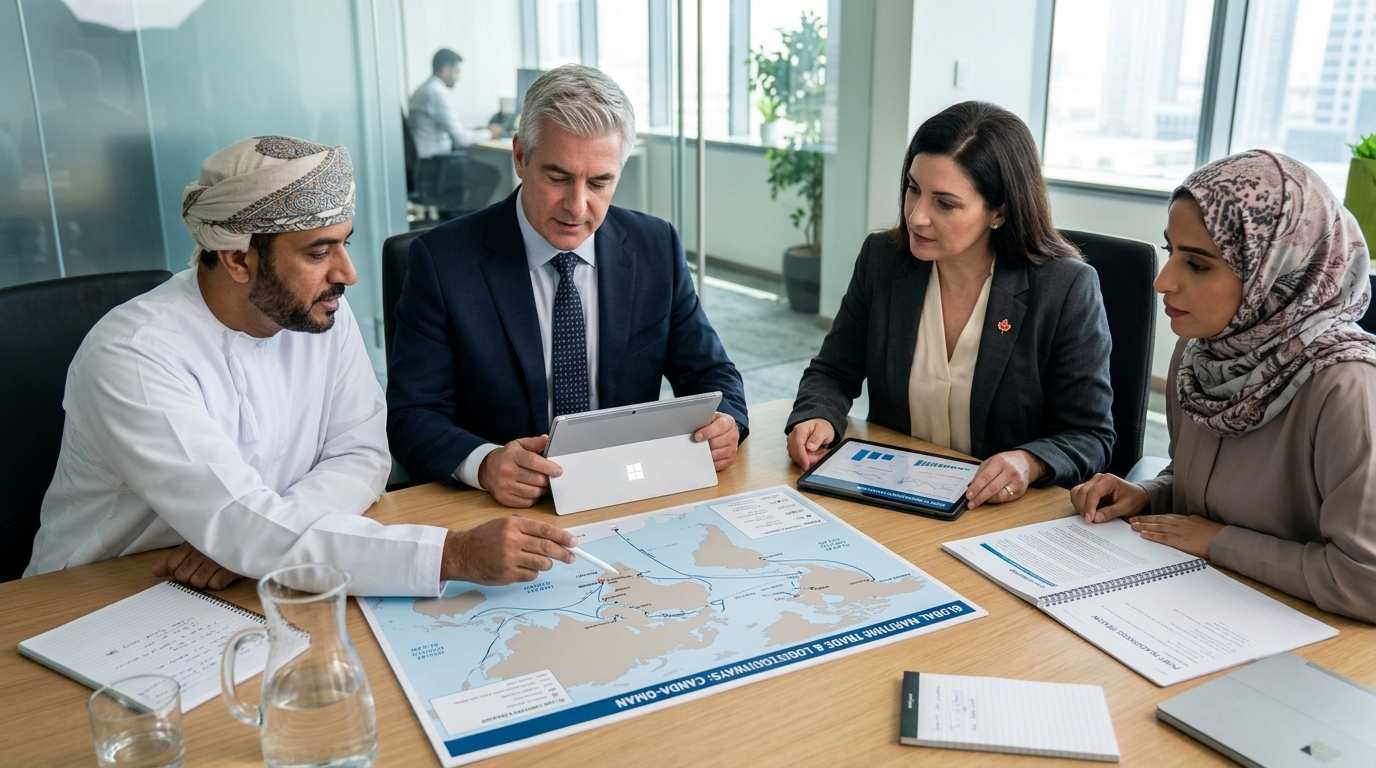
A trade corridor is more than a shipping route. It is an operating system connecting:
- market intelligence
- qualified counterparties
- standards and regulatory readiness
- logistics and customs planning
- contracts and risk allocation
- payment and financial coordination
- institutional dialogue
- post-market support and expansion
COBA works across these components to help create pathways that are repeatable, transparent and capable of supporting multiple companies and sectors over time.
Shared Principles for Corridor Development
Mutual Benefit
Projects should create legitimate value for both Canadian and Omani stakeholders.
Local Relevance
International solutions must be adapted to local law, culture, customer needs and operational realities.
Phased Execution
Pilot programs and measurable milestones should precede large-scale commitments where appropriate.
Responsible Engagement
Public-sector dialogue must be accurate, authorized and free from misleading claims.
Sustainability
Economic value should be developed with attention to environmental, social and long-term institutional outcomes.
COBA’s Role
COBA may support corridor development through:
- sector mapping and opportunity identification
- curated business and institutional engagement
- market-entry and partnership frameworks
- trade missions and sector delegations
- logistics and supply-chain coordination
- knowledge exchange and executive education
- project readiness and stakeholder alignment
- lawful economic advocacy and institutional proposals
- transparent monitoring and follow-through